Test: Thematic vocabulary, tag questions and phrasal verbs
10 preguntas de selección múltiple · Dificultad: Mixto · Unidad: Language in Use: gramática y vocabulario en contexto. Elige una alternativa y revisa la explicación.
Pregunta 1FácilIdentificar
Read the following dialogue about protecting the environment:
- Sophia: 'We should recycle all our plastic bottles, ________?' - Mateo: 'Yes, absolutely! It's a great way to reduce pollution in our city.'
Which tag question correctly completes Sophia's statement?
Ver respuesta y explicación
Respuesta correcta: B. Since the statement is positive and uses the modal verb 'should' ('We should recycle...'), the tag question must be negative and use the same modal verb ('shouldn't we?'). This is a basic rule of tag questions used to keep conversations alive.
Pregunta 2FácilComprender
Martín is doing a science project about energy conservation at his school in Concepción. His teacher told him to make sure all the computers are not wasting electricity at the end of the day.
What phrasal verb should Martín use to describe this action?
'I need to ________ all the computers before going home.'
Ver respuesta y explicación
Respuesta correcta: A. To stop a machine or device from working or using electricity, we use the phrasal verb 'turn off'. In this context, turning off the computers helps conserve energy, which aligns with the science project's goal.
Pregunta 3FácilIdentificar
In English class, Camila is writing an essay about global citizenship. She wants to check if her classmate agrees with her idea.
Choose the correct tag question to complete her sentence:
'Global citizens care about people from other countries, ________?'
Ver respuesta y explicación
Respuesta correcta: C. The main clause 'Global citizens care...' is in the present simple tense (positive). Since 'care' is a regular verb (not 'to be' or a modal), we use the auxiliary 'do/does'. For a positive statement with a plural subject (global citizens), we use the negative tag 'don't they?'.
Pregunta 4IntermedioAplicar
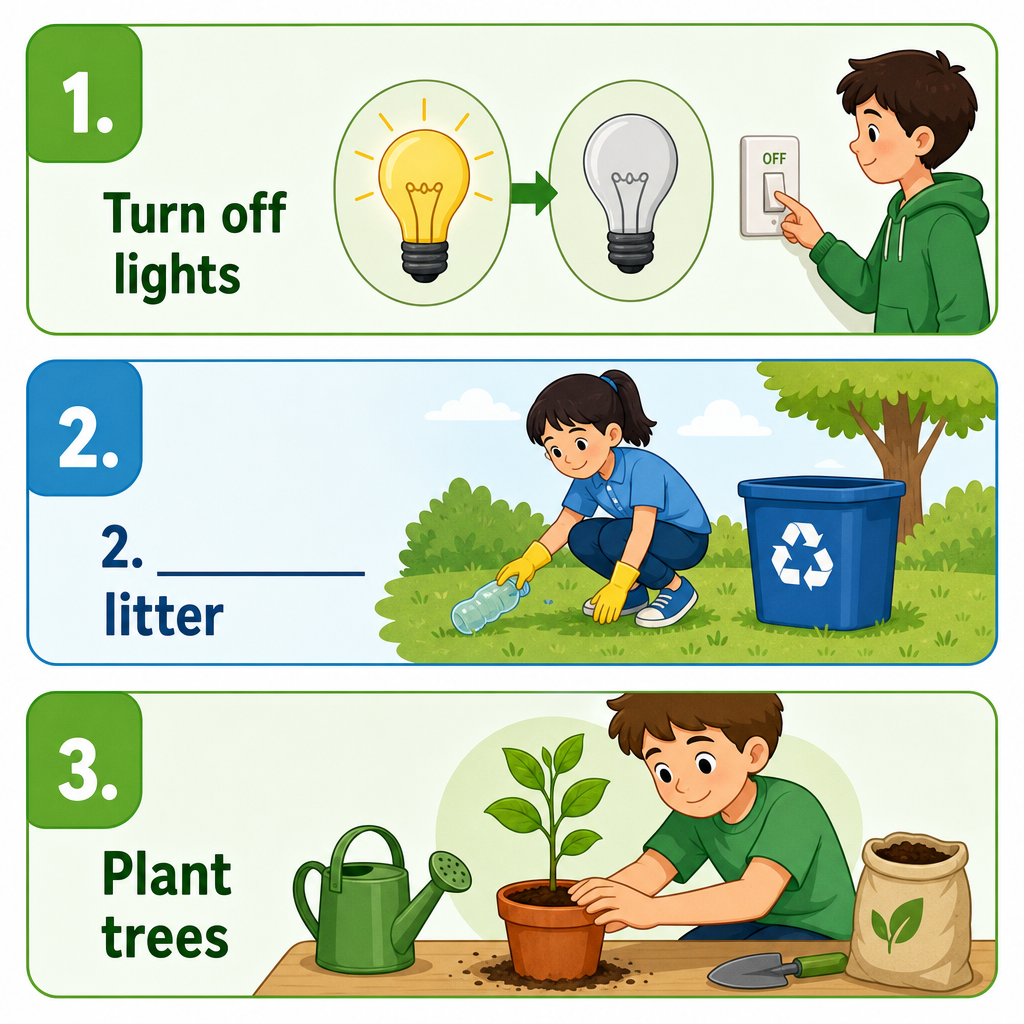
De acuerdo con la imagen adjunta, look at the diagram showing a student's daily routine to help the environment in Chile.
According to the sequence of actions in the diagram, what is the correct phrasal verb that represents Step 2?
Ver respuesta y explicación
Respuesta correcta: A. Step 2 in the diagram shows a person bending down to collect litter/rubbish from the ground to place it in a bin. The phrasal verb that means to lift something up from a surface (like trash from the ground) is 'pick up'.
Pregunta 5IntermedioAplicar
Read the conversation between two classmates working on a science presentation about renewable energy:
- Diego: 'We didn't find any information about solar panels in Chile, ________?' - Francisca: 'Actually, yes we did! I found a great article on the internet.'
Which tag question correctly completes Diego's question?
Ver respuesta y explicación
Respuesta correcta: A. The statement 'We didn't find...' is negative and in the past simple tense. To form the tag question, we must use the positive auxiliary verb 'did' followed by the subject pronoun 'we', resulting in 'did we?'.
Pregunta 6IntermedioComprender
Read the paragraph about global citizenship and answer the question:
'To be a good global citizen, you need to understand different cultures and care about global issues like climate change. If you don't know much about these topics, you can ________ information in books or reliable websites. It is also important to ________ with people from different backgrounds to collaborate on solutions.'
Which pair of phrasal verbs correctly completes the paragraph?
Ver respuesta y explicación
Respuesta correcta: A. The phrasal verb 'look up' means to search for information in a book or on a website, which fits the first blank. 'Get along (with)' means to have a friendly relationship with someone, which fits the second blank about collaborating with people from different backgrounds.
Pregunta 7DifícilAnalizar
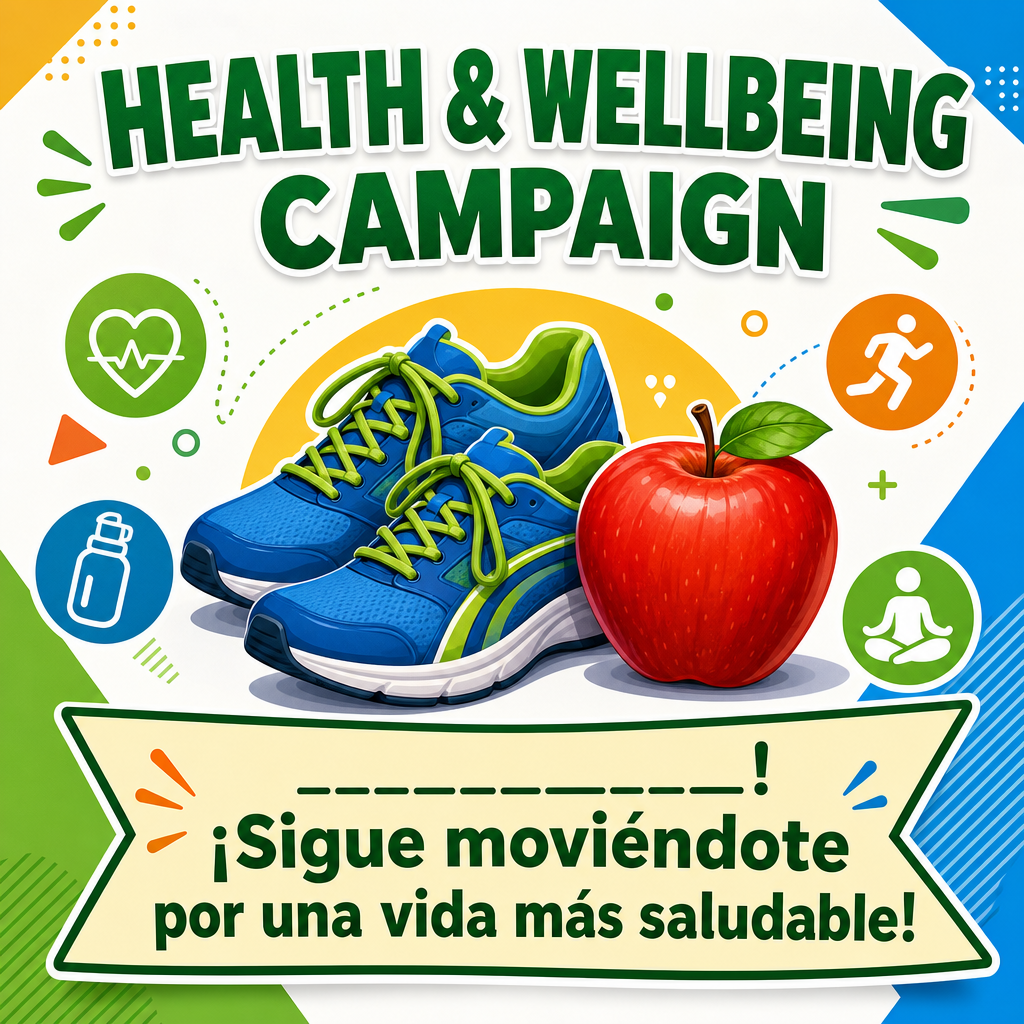
De acuerdo con la imagen adjunta, examine the poster of a school campaign about health and wellbeing in Chile.
Based on the message in the poster, what is the best phrasal verb to complete the slogan under the running shoes?
Ver respuesta y explicación
Respuesta correcta: B. The poster promotes health, exercise, and perseverance. The phrase 'Don't give up' means to not stop trying or to not surrender, which is the perfect motivational slogan for a physical fitness campaign urging students to stay active.
Pregunta 8DifícilAnalizar
Read the text about a scientific discovery and identify the correct combination of a phrasal verb and a tag question:
'Scientists in Chile wanted to ________ why the water in a southern lake was changing color. They did several experiments and eventually solved the mystery. They solved it quickly, ________?'
Ver respuesta y explicación
Respuesta correcta: A. 'Find out' is the correct phrasal verb because it means to discover a fact or obtain knowledge about something. The second sentence 'They solved it quickly' is in the past simple (positive), so its tag question must be negative and in the past simple: 'didn't they?'.
Pregunta 9DifícilAplicar
During a debate on global warming and environmental problems, a student says:
'We rarely see people cleaning up the beaches in our region, ________?'
Which tag question is grammatically correct and appropriate for this sentence? (Hint: Pay attention to the frequency adverb).
Ver respuesta y explicación
Respuesta correcta: B. The adverb 'rarely' has a negative meaning. When a sentence contains a word with a negative meaning (like rarely, seldom, or never), the statement is treated as negative, so the tag question must be positive: 'do we?'.
Pregunta 10DifícilComprender
Read the diary entry of a student participating in an international youth exchange program:
'Yesterday, while I was cleaning the school garden, I ________ an old book about native Chilean plants. I opened it and learned that some of these species are endangered. We must protect them, ________?'
Which option correctly completes the diary entry?
Ver respuesta y explicación
Respuesta correcta: A. 'Come across' (past tense: 'came across') means to find something by chance, which fits finding the old book. The statement 'We must protect them' uses the modal verb 'must' in a positive form, so the tag question must be the negative modal form 'mustn't we?'.