10 preguntas de selección múltiple · Dificultad: Mixto · Unidad: Speaking & Interaction: comunicación oral fluida. Elige una alternativa y revisa la explicación.
Pregunta 1FácilIdentificar
When we ask a Yes/No question in English, our voice usually goes up at the end (rising intonation). Which of the following questions should be pronounced with a rising intonation?
Ver respuesta y explicación
Respuesta correcta: B. Yes/No questions (like 'Do you like playing video games?') typically end with a rising intonation. Questions starting with Wh- words (Where, What, Why) generally end with a falling intonation.
Pregunta 2FácilIdentificar
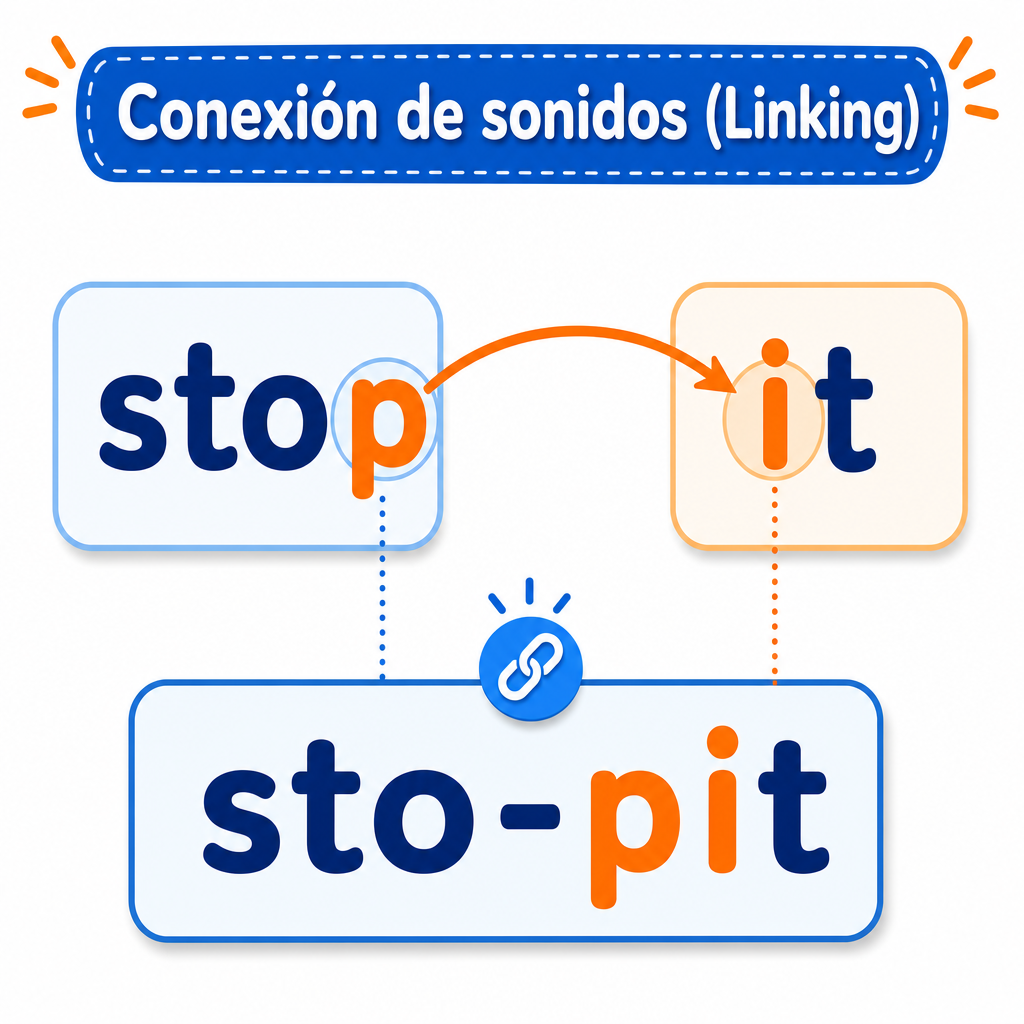
De acuerdo con la imagen adjunta, look at the diagram showing how sounds connect. When a word ending in a consonant sound is followed by a word starting with a vowel sound, they link together. According to this rule, how would a native speaker pronounce 'stop it' in natural connected speech?
Ver respuesta y explicación
Respuesta correcta: A. In connected speech, consonant-to-vowel linking causes 'stop it' to blend together, sounding like 'sto-pit' because the final consonant sound /p/ links to the initial vowel sound /ɪ/.
Pregunta 3FácilIdentificar
In English, we often use contractions to speak more naturally and fluently. Which option shows the correct natural contraction for 'I am not going to' that you might hear in everyday informal speech?
Ver respuesta y explicación
Respuesta correcta: B. 'I'm not gonna' is the natural informal spoken contraction for 'I am not going to', combining the standard contraction 'I'm' with the reduction 'gonna' for 'going to'.
Pregunta 4IntermedioAnalizar
English is a stress-timed language, which means we stress important content words (nouns, verbs, adjectives) and reduce function words (pronouns, prepositions, auxiliary verbs). In the sentence 'She is a student from Chile', which words are stressed to keep a natural English rhythm?
Ver respuesta y explicación
Respuesta correcta: B. 'Student' (noun) and 'Chile' (proper noun) are content words that carry the main meaning, so they receive the primary stress. 'She' (pronoun), 'is' (verb/auxiliary), 'a' (article), and 'from' (preposition) are function words and are usually unstressed or reduced.
Pregunta 5IntermedioAnalizar
De acuerdo con la imagen adjunta, look at the diagram showing word stress patterns. In English, words have stressed syllables that are louder and longer. Where is the main stress in the word 'computer'?
Ver respuesta y explicación
Respuesta correcta: B. The word 'computer' is a three-syllable word with the stress on the second syllable: /kəmˈpjuːtər/ (com-PU-ter).
Pregunta 6IntermedioAplicar
During an impromptu speaking activity in class, you draw a card that says 'My favorite hobby'. You have to speak for 45 seconds without stopping. What is the best strategy to maintain fluency during this task?
Ver respuesta y explicación
Respuesta correcta: C. Using natural hesitation fillers ('well', 'you know', 'let me see') helps maintain the flow of speech (fluency) during impromptu speaking, preventing long silent pauses without requiring written preparation.
Pregunta 7DifícilAnalizar
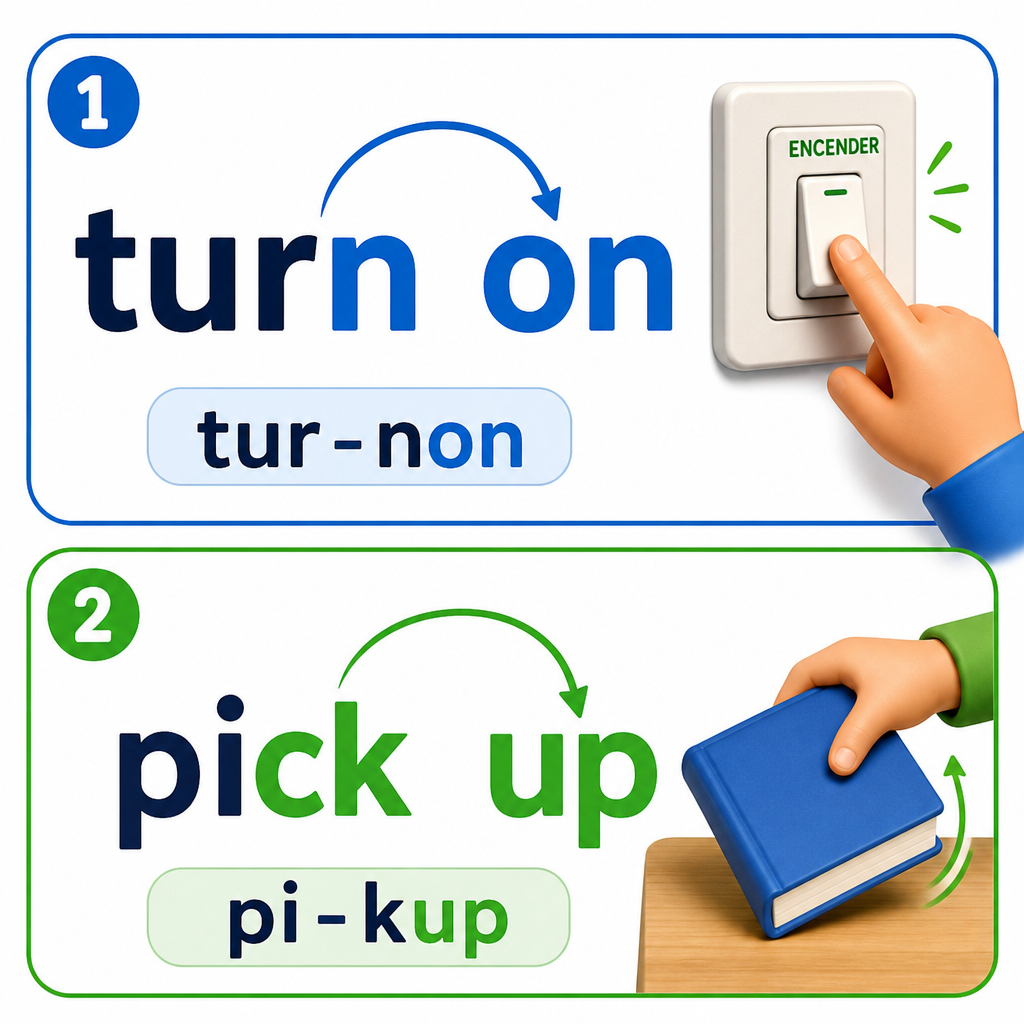
De acuerdo con la imagen adjunta, observe the connected speech markings in the provided image. When we say 'turn on' and 'pick up' at a natural speed, how do the ending consonants link to the next vowel sounds?
Ver respuesta y explicación
Respuesta correcta: A. In connected speech, the final consonant sound of 'turn' (/n/) links to the vowel of 'on' (/ɒ/), sounding like 'tur-non'. Similarly, 'pick up' links to sound like 'pi-kup'. This is called consonant-to-vowel linking.
Pregunta 8DifícilAnalizar
In English, function words like 'to', 'for', and 'of' are often reduced to their weak forms in fast speech. For example, 'for' is often pronounced as /fər/ instead of /fɔːr/. In which of the following sentences will the word 'for' be pronounced in its weak, reduced form?
Ver respuesta y explicación
Respuesta correcta: B. Prepositions like 'for' are reduced to their weak form (/fər/) when they are in the middle of a sentence followed by a stressed content word ('sister'). When they appear at the very end of a sentence (as in options A, C, and D), they must be pronounced in their strong form.
Pregunta 9DifícilAplicar
Imagine you are giving a 45-second impromptu talk about 'My Last Vacation'. To sound natural, fluent, and connected, which of the following spoken sentences demonstrates the best use of contractions and linking?
Ver respuesta y explicación
Respuesta correcta: B. Option B represents natural connected speech where words flow together without robotic pauses (indicated by the underscores linking 'beach_and_it' and 'was_amazing'), which is essential for natural English rhythm and fluency.
Pregunta 10DifícilAnalizar
Read this conversation. - Speaker A: 'Are you coming to the party?' - Speaker B: 'What time does it start?'
How should the intonation of these two questions change at the end?
Ver respuesta y explicación
Respuesta correcta: C. Speaker A is asking a Yes/No question ('Are you coming...?'), which requires a rising intonation. Speaker B is asking a Wh- question ('What time...?'), which requires a falling intonation.