10 preguntas de selección múltiple · Dificultad: Mixto · Unidad: Advanced Grammar & Vocabulary. Elige una alternativa y revisa la explicación.
Pregunta 1FácilAplicar
Choose the correct passive voice form of the following sentence: 'The school principal announced the new recycling campaign yesterday.'
Ver respuesta y explicación
Respuesta correcta: B. La oración original está en pasado simple ('announced'). Para transformarla a voz pasiva, se utiliza el verbo 'to be' en pasado simple ('was' porque el sujeto 'the new recycling campaign' es singular) seguido del participio pasado del verbo principal ('announced').
Pregunta 2FácilAplicar
Identify the correct reported speech version of this statement: 'I love English classes,' said Camila.
Ver respuesta y explicación
Respuesta correcta: A. En reported speech, cuando el verbo introductorio está en pasado ('said'), el presente simple ('love') cambia a pasado simple ('loved') por concordancia temporal (backshifting), y el pronombre 'I' cambia a 'she' para referirse a Camila.
Pregunta 3FácilComprender
In academic and scientific writing, why do we often use the passive voice instead of the active voice?
Ver respuesta y explicación
Respuesta correcta: C. El uso principal de la voz pasiva en textos académicos y científicos es desviar la atención del agente (quien realiza la acción) y poner el foco en el proceso, la acción o el objeto de estudio.
Pregunta 4IntermedioAplicar
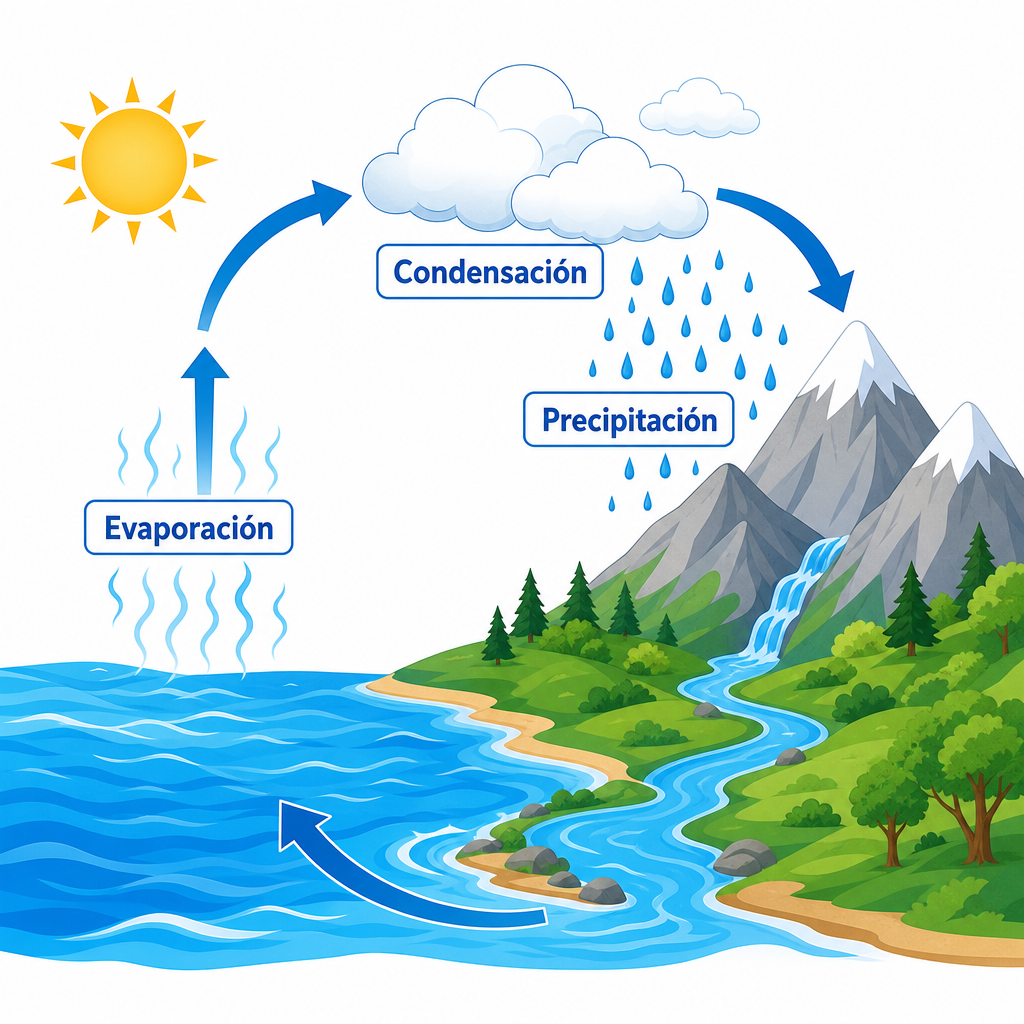
De acuerdo con la imagen adjunta, look at the diagram of the water cycle. Based on the process shown in the image, which of the following options correctly describes one of the steps using the passive voice?
Ver respuesta y explicación
Respuesta correcta: B. La opción B describe correctamente el proceso en presente simple pasivo ('is evaporated'), que es el tiempo adecuado para hechos generales y procesos científicos como el ciclo del agua, identificando correctamente el objeto receptor de la acción.
Pregunta 5IntermedioAnalizar
A student wrote the following sentence in direct speech: 'We will present our history project tomorrow.' Which of the following is the correct reported speech version of this sentence?
Ver respuesta y explicación
Respuesta correcta: B. Al pasar a reported speech, el auxiliar 'will' cambia a 'would' (backshifting), el pronombre 'we' cambia a 'they', el posesivo 'our' cambia a 'their', y la expresión de tiempo 'tomorrow' cambia a 'the following day' o 'the next day'.
Pregunta 6IntermedioAplicar
Select the option that correctly completes the gap in this news report: 'A historic copper mine ________ by researchers in northern Chile last month.'
Ver respuesta y explicación
Respuesta correcta: A. La expresión de tiempo 'last month' indica que la acción ocurrió y finalizó en el pasado. Por lo tanto, se requiere la voz pasiva en pasado simple: 'was discovered'.
Pregunta 7DifícilAnalizar
De acuerdo con la imagen adjunta, read the school news announcement shown in the image. If you want to report what the principal said to your parents using reported speech, which option is grammatically correct?
Ver respuesta y explicación
Respuesta correcta: B. El anuncio original en la imagen dice: 'We are building a new science lab here' (presente continuo). Al reportarlo en pasado, el presente continuo cambia a pasado continuo ('were building') y el adverbio de lugar 'here' cambia a 'there'.
Pregunta 8DifícilAnalizar
Consider the sentence: 'The scientists have analyzed the lab samples.' Which is the correct passive voice transformation?
Ver respuesta y explicación
Respuesta correcta: C. La oración activa está en presente perfecto ('have analyzed'). Para la voz pasiva, mantenemos el tiempo verbal usando el verbo 'to be' en presente perfecto ('have been' ya que 'samples' es plural) y el participio del verbo principal ('analyzed').
Pregunta 9DifícilEvaluar
Read the direct question: 'Have you finished your homework?' asked the teacher. Choose the correct indirect (reported) question.
Ver respuesta y explicación
Respuesta correcta: B. Al reportar una pregunta de tipo Yes/No en presente perfecto ('Have you finished...'), se introduce con 'if' o 'whether', el sujeto se coloca antes del verbo (orden de afirmación, no de pregunta), y el verbo retrocede al pasado perfecto ('had finished').
Pregunta 10DifícilSintetizar
Read the statement: 'We will deliver the Chromebooks to the students next Monday.' Which option represents the most appropriate passive voice construction for a formal school report?
Ver respuesta y explicación
Respuesta correcta: B. Para el tiempo futuro con 'will' ('will deliver'), la estructura pasiva correcta es 'will be' + participio pasado ('will be delivered'). Esto mantiene el tiempo futuro y el registro formal omitiendo el agente innecesario ('by us').