10 preguntas de selección múltiple · Dificultad: Mixto · Unidad: Listening & Media. Elige una alternativa y revisa la explicación.
Pregunta 1FácilIdentificar
In a travel vlog, the host says: 'We're gonna visit the San Cristóbal Hill today!' What does the contracted word 'gonna' mean in standard English?
Ver respuesta y explicación
Respuesta correcta: A. The word 'gonna' is a very common spoken reduction or contraction of 'going to' in informal, natural English.
Pregunta 2FácilIdentificar
De acuerdo con la imagen adjunta, look at the informal text message from a Chilean travel vlogger to their editor. What does the word 'wanna' represent in standard English?
Ver respuesta y explicación
Respuesta correcta: B. In connected speech, 'want to' is frequently reduced to 'wanna' to make spoken English flow faster and more naturally.
Pregunta 3FácilComprender
Why do native English speakers use connected speech and reductions like 'gonna' or 'wanna' when they talk in videos and songs?
Ver respuesta y explicación
Respuesta correcta: C. Connected speech and reductions are natural phenomena in spoken English that allow speakers to link words together smoothly and maintain a natural rhythm.
Pregunta 4IntermedioAplicar
A travel vlogger says: 'We went to Torres del Paine and we wanna climb the mountain tomorrow.' Which of the following sentences correctly rewrites this using standard, non-reduced grammar in the Past Simple and future intention?
Ver respuesta y explicación
Respuesta correcta: A. 'We went to' is already in the Past Simple, and 'wanna' is the reduced form of 'want to'. Therefore, the correct non-reduced sentence is 'We went to Torres del Paine and we want to climb...'.
Pregunta 5IntermedioAnalizar
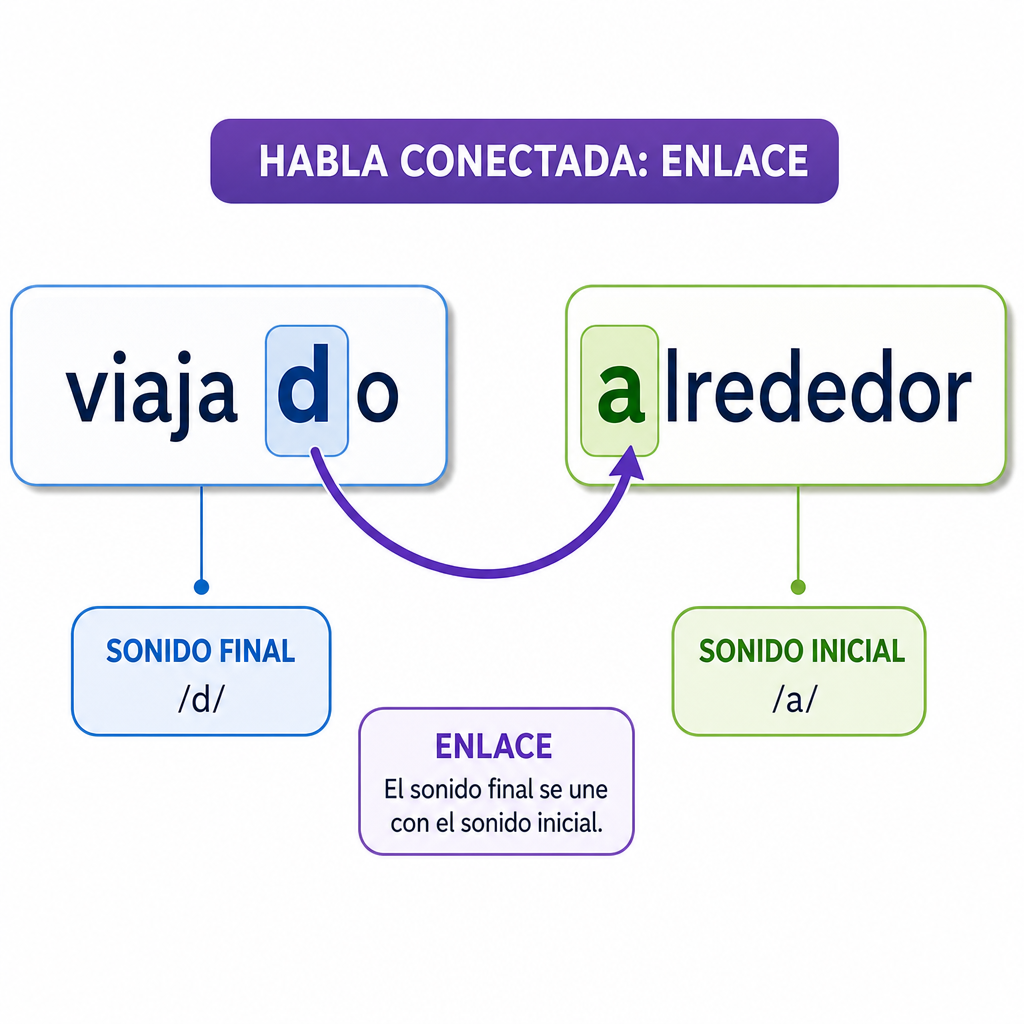
De acuerdo con la imagen adjunta, look at the diagram showing how words link in connected speech. When a travel vlogger says 'travelled_around', what happens to the sound between the two words?
Ver respuesta y explicación
Respuesta correcta: A. In connected speech, consonant-to-vowel linking occurs. The final consonant sound /d/ of 'travelled' naturally links to the starting vowel sound /ə/ of 'around', sounding like 'travel-da-round'.
Pregunta 6IntermedioComprender
You are watching a travel video without subtitles. The host says: 'Last year, we visited Chiloé and we loved it.' How does 'loved it' sound in natural, connected speech?
Ver respuesta y explicación
Respuesta correcta: B. When a word ending in a consonant sound (loved /lʌvd/) is followed by a word starting with a vowel sound (it /ɪt/), they link together, creating the blended sound 'lov-dit'.
Pregunta 7DifícilAnalizar
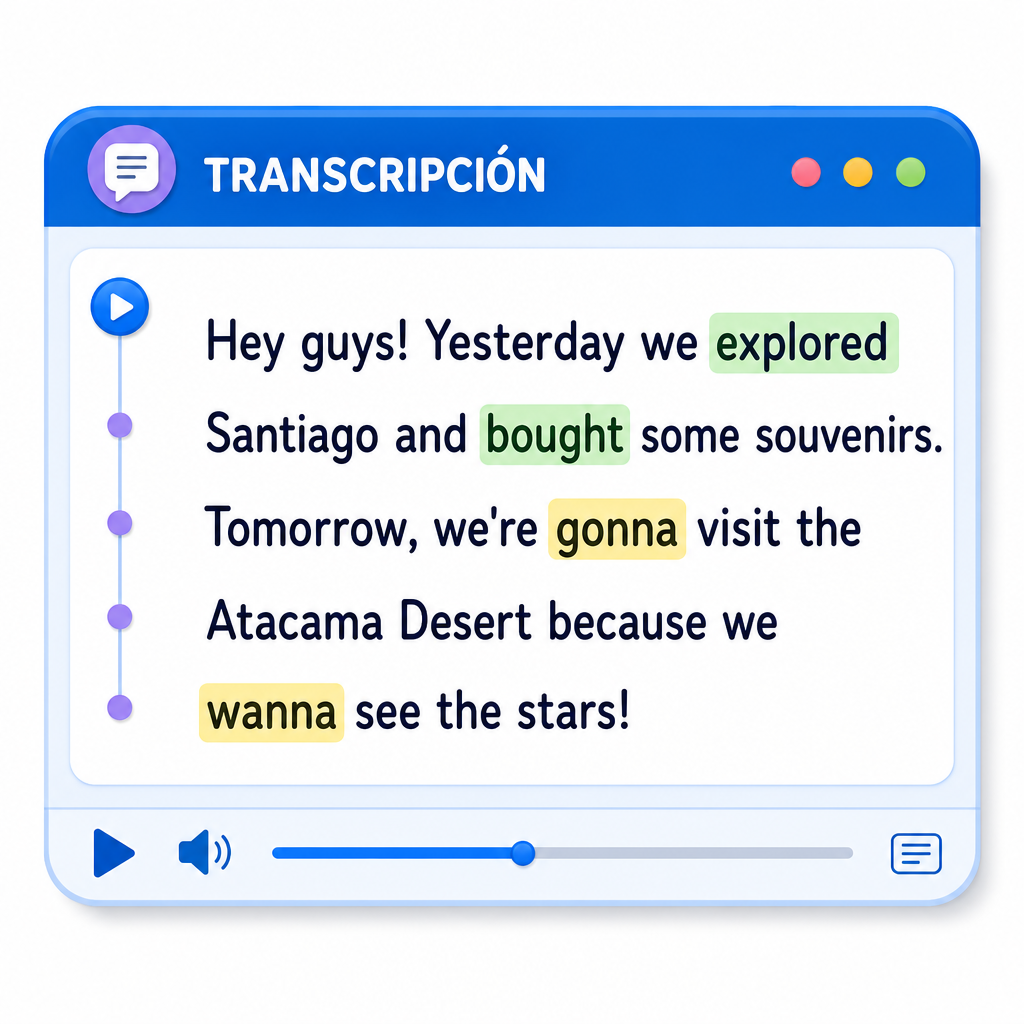
De acuerdo con la imagen adjunta, analyze the transcription of a vlogger's audio track in the image. Which option correctly identifies both the Past Simple verbs used to describe their past actions and the reduced future forms they plan to do?
Ver respuesta y explicación
Respuesta correcta: B. 'Explored' and 'bought' are verbs in the Past Simple describing completed actions in the past. 'Gonna' (going to) and 'wanna' (want to) are reduced forms used to express future plans and desires.
Pregunta 8DifícilAplicar
Imagine you are writing a summary of a vlogger's trip to Valparaíso. They said in the video: 'We walked up the hills and we're gonna take the funicular railway now.' How should you write this in a formal school report?
Ver respuesta y explicación
Respuesta correcta: B. In formal written reports, informal spoken reductions like 'gonna' must be expanded to their full, formal written form, which is 'going to', while keeping the Past Simple 'walked' correct.
Pregunta 9DifícilAnalizar
A travel vlogger says quickly: 'We wanted_to see the penguins, so we went_to Punta Arenas.' In connected fast speech, how do 'wanted to' and 'went to' typically sound?
Ver respuesta y explicación
Respuesta correcta: B. In natural, fast connected speech, the preposition 'to' is often unstressed and reduces to a weak 'schwa' sound (/tə/), making 'wanted to' sound like 'wan-tuh' or 'wanna' and 'went to' sound like 'wen-tuh'.
Pregunta 10DifícilComprender
When listening to authentic media like English songs or YouTube travel channels without subtitles, why is it sometimes difficult to identify Past Simple verbs ending in '-ed' (like 'talked', 'played', 'visited')?
Ver respuesta y explicación
Respuesta correcta: B. In connected speech, final consonant sounds like /t/, /d/, or /ɪd/ from '-ed' suffixes link with following vowel sounds or get blended with next consonants, making them hard for non-native listeners to isolate.